
How To Invest Under 18
by Emmanuel Modu, Author of TeenVestor: The Practical Investment Guide for Teens and Their Parents
Updated: July 3, 2026

How do you invest as a teenager? If you're under 18, you can't open a brokerage account on your own — but with a parent's help, you can start investing today through a custodial account or a teen account, often with as little as $1. This guide walks you through every step: choosing the account, opening it, and making your first investment at 13, 14, 15, 16, or 17.
The most common question from teens who visit this site is "how old do I have to be to invest in stocks?" This article answers it — and shows you exactly what to do at every age, with your parents' help.
Advantages of Learning to Invest as a Teenager
What are the advantages of investing under 18? First, you will get ahead of all your peers. While your friends worry about affording the latest device or fashion, you will be investing in their manufacturers. While your classmates spend their holiday gift money on a new game system, you will be stashing money in financial assets like stocks and funds.
Investment principles learned early will stay with you forever. Money grows by earning interest on interest, also known as compounding. Once you appreciate that, and invest long-term in stocks and funds, you will realize that a bit of money invested today can produce much more tomorrow.
Two very important factors determine how teenagers under 18 (minors) can invest:
1. Teens under 18 generally cannot invest on their own. They must invest through custodial accounts supervised by adults, or through teen accounts a parent helps set up.
2. Teens generally have very little money, which limits the variety of investments they can make. For example, many mutual funds require minimum investments of thousands of dollars. (ETFs give you a way around this, as you will see later.)
How to Start Investing as a Teenager
You can start investing as a teenager — before you turn 18 — by following seven basic steps, with a parent's help to open a brokerage account:
1. Gain basic knowledge. Go to sites that specialize in teaching teens the basics of stocks. See our list of top sites for teen investors.
2. Stick to your interests at the beginning. Looking for companies that suit your interests and companies that are in your state will keep you engaged. Later, you can expand your investment universe.
3. Find out exactly what companies do. You should get detailed information about any company.
4. Get basic financial data. Understanding basic financial measures will help you avoid serious investment mistakes.
5. Experiment with dummy, mock, or virtual portfolios. Several companies offer free dummy trading platforms. They help you step gently into stock investing without risking your money.
6. Choose the right brokerage account for teens. Online brokers with no fees and no minimums are ideal.
7. Avoid scams. Stay away from penny stocks and anyone who promises returns that are too good to be true.
Each step is explained in detail in our companion article, 7 Steps to Investing as a Teenager.
The rest of this guide covers the two things every one of those steps depends on: the account you'll invest through, and what you'll invest in. On the account side, we explain custodial accounts for minors and teen-owned accounts like Fidelity Youth. On the investment side, we go beyond stocks to the full range of affordable choices for teens: stocks, exchange-traded funds (ETFs), United States savings bonds, and certificates of deposit (CDs) — plus a pointer to our article on teen investors and taxes, a subject most young investors miss.
Investing When You are Almost Broke
One of the main obstacles for teens interested in investing is having the cash to do so. This problem has started to disappear. You can now start investing with as little as $1. Financial innovation lets you buy a fraction of a share, as you will learn later in this article. But most teens who want to invest will not find investing only $1 appealing.
So let's explore other ways to get money for investing in stocks. If you have a job, you can set aside money periodically to invest in the stock market. It does not matter whether it is money for chores around the house or money from an actual job.
If you are lucky enough to get a regular allowance from your parents, you can allocate a piece of it for investing. You can even ask them to increase the allowance so you can put the increase into stocks.
Grandparents are always keen to encourage financial responsibility among their grandkids. You can start your money-raising campaign with them. If you have relatives who periodically give you cash gifts, let them know you intend to put some of that money into stocks. Signaling your intentions may even encourage them to give you more. They will know you are responsible with the money.
If you find you still do not have enough money to invest, or any money at all, do not fret. You can learn the basics of investing with dummy portfolios, which we discuss later.
Custodial Accounts for Teen Investors
How old do you have to be to invest in stocks on your own? If you are under 18, you generally cannot open a brokerage account alone. As a minor, you can invest under the supervision of your parent (or another adult) through a custodial account. Your parent will have to sign you up for a custodial account offered by an online broker.
Without boring you with unnecessary details, you only need to know that two types of custodial accounts are used for minors:
1. One account is established under the Uniform Gift to Minors Act (UGMA); and
2. The other account is established under the Uniform Transfer to Minors Act (UTMA).
Either account lets your parents give you money so you can buy stocks or other assets under their supervision. Which type you open depends largely on the state where you live.
You would own the assets in the custodial account. Your parent would control the investments in it (hopefully, with your help) until you are no longer a minor. Depending on your state and the type of account, that usually means age 18 — but in some states, the custodianship doesn't end until you turn 21, or even 25 for certain accounts.
A few big brokers also offer teen accounts for ages 13 to 17, such as the Fidelity Youth Account and the Schwab Teen Investor account. With these, you control the account yourself, and your parent stays connected. See How to Choose an Online Broker for Teens for criteria for selecting a broker.
Important considerations in choosing an online trading account include:
• No stock trading fees. Find online brokers that charge $0 to buy and sell stocks and ETFs.
• No minimum balance. Make sure the broker does not require a sizeable minimum balance in a trading account. Many now offer a $0 minimum.
• Fractional shares. If you want to invest as little as $1 in reputable companies with high stock prices, the broker must allow you to buy fractions of a share.
• Low or no monthly fees. Some youth apps charge subscriptions that eat into small accounts.

Choice of Online Brokers for Teen Investors
It has never been easier for teens to invest in stocks and other financial assets. Financial innovations by online brokers, such as no-fee stock trading, fractional shares, and well-designed investment apps, have made it easier for teens like you to become investors. (Please see our homepage for more about the articles and tools on this site.)
Here are the brokers and apps you and your parents may want to investigate, split into two groups.
Traditional, Established Brokers
These firms have been around a long time. They charge no commissions on stocks and ETFs. They have no account minimums and no subscription fees. They are also the most durable and the cheapest to leave.
• Fidelity. Offers both custodial accounts and the teen-owned Fidelity Youth Account. Commission-free, with no minimum and no subscription.
• Charles Schwab. Now owns TD Ameritrade. Offers custodial accounts and the Schwab Teen Investor account.
• Vanguard. Offers custodial (UGMA/UTMA) accounts. A large, long-established firm known for low-cost index funds.
• E*TRADE. From Morgan Stanley. Offers custodial accounts, and even custodial IRAs for teens with earned income.
• Interactive Brokers. Offers custodial accounts. A powerful platform, though more advanced than most beginners need.
• Ally Invest. Offers custodial accounts with commission-free stocks and ETFs, alongside Ally's online banking.
• Robinhood. The app that helped make commission-free trading standard. It previously did not offer custodial accounts. It now does, so teens can investthrough a Robinhood custodial account.
Youth-Focused Apps
These apps are built for teens or families. They often add lessons, an allowance tool, a debit card, or parental controls. Most charge a subscription. Some can be costlier to leave. Weigh the extras against the fees.
• Greenlight. A family money app with a debit card, allowance,, chores, and parent-approved investing. Subscription-based.
• Acorns. Offers custodial (UGMA/UTMA) investing for kids through Acorns Early, with automated, hands-off portfolios. Subscription-based.
• Stash. Offers a parent-run custodial account it calls a Kids Portfolio. Subscription-based. This is also where Stockpile's former customers were moved.
• Bloom. A teen investing app with custodial accounts, fractional shares, and built-in lessons. Subscription-based.
Some companies on this list, such as Greenlight and Bloom, were built to serve teen investors and their parents. Their apps make it easy to open accounts, and teens can invest with a parent's approval. Fidelity's Youth Account, launched in 2021, made a big splash in the press. It gives teens an easy way to invest in stocks. Note that a parent needs a regular Fidelity account to register their teen.
Buying Individual Shares of Stock
If you want to buy individual stocks, thousands are listed on US stock exchanges. Researching each of these companies is an impossible task. It is probably wiser to begin with big companies, such as those in an index like the Dow Jones Industrial Average (the Dow). Some aspiring teen investors also begin by choosing stocks they already know. We discuss both options below.
The Dow Stocks
The Dow is an index that gives you a general idea of the health of the overall stock market. It consists of 30 companies. You may already know some of them, such as Verizon, Nike, McDonald's, Microsoft, and Coca-Cola. Here is a link to the companies in the Dow, so you can see the rest of the big companies in the index and their stock symbols.
Most Dow share prices range from under $50 to several hundred dollars. Even if you want to invest less money, for example $5, you can do so through online brokers that allow you to buy fractional shares, as discussed earlier.
If you buy individual stocks, it becomes even more important to learn the basics of stock investing. Without an understanding of investing fundamentals, you risk quickly losing whatever little money you cobble together to start building your nest egg.
.
Stocks of Companies You Already Know
If the stocks in the Dow don't interest you, look into stocks of companies that teens like. The investment bank Piper Sandler surveys thousands of US teens in a project called Taking Stock With Teens. Its most recent survey, from Fall 2025, polled about 11,000 teens. It covers shoes, restaurants, snacks, clothing, and many other consumer items and services young people use.
Basing stock purchases on brand recognition is probably not the best way to decide what stocks to buy. But the companies in the survey may give you some initial investment ideas. Later, when you get more experienced, you can do fundamental research to see which stocks are worth your money.
Here are some well-known teen brands and the public companies behind them:
• Nike and Converse: Nike, Inc. (stock symbol: NKE)
• Hollister: Abercrombie & Fitch Co. (stock symbol: ANF)
• American Eagle: American Eagle Outfitters, Inc. (stock symbol: AEO)
• UGG and Hoka: Deckers Outdoor Corporation (stock symbol: DECK)
• Vans: VF Corporation (stock symbol: VFC)
• Lululemon: Lululemon Athletica Inc. (stock symbol: LULU)
• Coach and Kate Spade: Tapestry, Inc. (stock symbol: TPR)
• Michael Kors: Capri Holdings (stock symbol: CPRI)
• McDonald's, Chipotle, and Starbucks: McDonald's Corporation (MCD), Chipotle Mexican Grill, Inc. (CMG), and Starbucks Corporation (SBUX)
• Goldfish crackers: The Campbell's Company (stock symbol: CPB)
• Lay's: PepsiCo, Inc. (stock symbol: PEP)
• Apple Pay, Cash App, and PayPal: Apple, Inc. (AAPL), Block, Inc. (XYZ), and PayPal Holdings, Inc. (PYPL)
Getting Information about Stocks
As a starting point, get a copy of the annual report of any company you may want to invest in. An annual report is a document most public companies use to disclose corporate information to their stockholders every year. It is a state-of-the-company report. It usually includes a letter from the chief executive officer and the company's financial data. It also covers results of operations, new product plans, subsidiary activities, and research on future programs.
You can get any company's annual report with a quick Google search. For example, if you want the annual report for Nike, enter 'Nike annual report' in the search box. We did such a search and ended up on a Nike website page with all of the company's annual reports.
You can get other information about any company from Yahoo!Finance, such as the company's stock symbol (which you need for trading) and its stock price. For example, type Nike in the search box on the Yahoo!Finance landing page. You will see information about NKE, Nike's stock symbol.
It is not always obvious which company makes a particular product just from its name. A simple internet search will tell you. For example, Goldfish crackers are made by The Campbell's Company. Lay's potato chips are made by PepsiCo, Inc. Both appear in the list of favorite teen brands above.
Using a Mock Portfolio to Practice Investing in Stocks
In an earlier section, I discussed the fact that most teen investors don’t have much money to invest in stocks even if they can spend as little as $1 to buy fractions of shares. If you find yourself in this situation, there are a few sites that will allow you to set up a mock stock portfolio and trade stocks with virtual dollars. With these sites, you can play with stocks without risking any money but you will start to learn how the stock market moves up and down. More importantly, it will show you that investing in stocks is not a way to get rich quickly.
With these mock portfolio sites, you can set up a dummy portfolio and the site will tally up the value of your stocks on a daily basis so you can see how the value of your portfolio moves on a daily basis. The websites use real trading data from US stock exchanges to tabulate the value of the portfolios. To set up your own dummy stock portfolio, you’d normally have to join a “stock market game on the site or set up your own game (if the site allows it).
Mock portfolio portals include: MarketWatch Virtual Stock Exchange, Wall Street Survivor, and How the Market Works.
Investing in an Index-Based Exchange Traded Fund (ETF)
As a teen investor, you probably want to reduce the risk in your initial investments. Buying one share of stock, even the stock of a big company, may still put your money at risk.
Exchange-traded funds (ETFs) are investments that represent a diversified group of companies but trade just like stocks. ETFs have been around since about 1993, which is a short time for an investment product. They have been highly successful in attracting investors who want to reduce the risk they take in buying stocks.
Index-Based ETFs
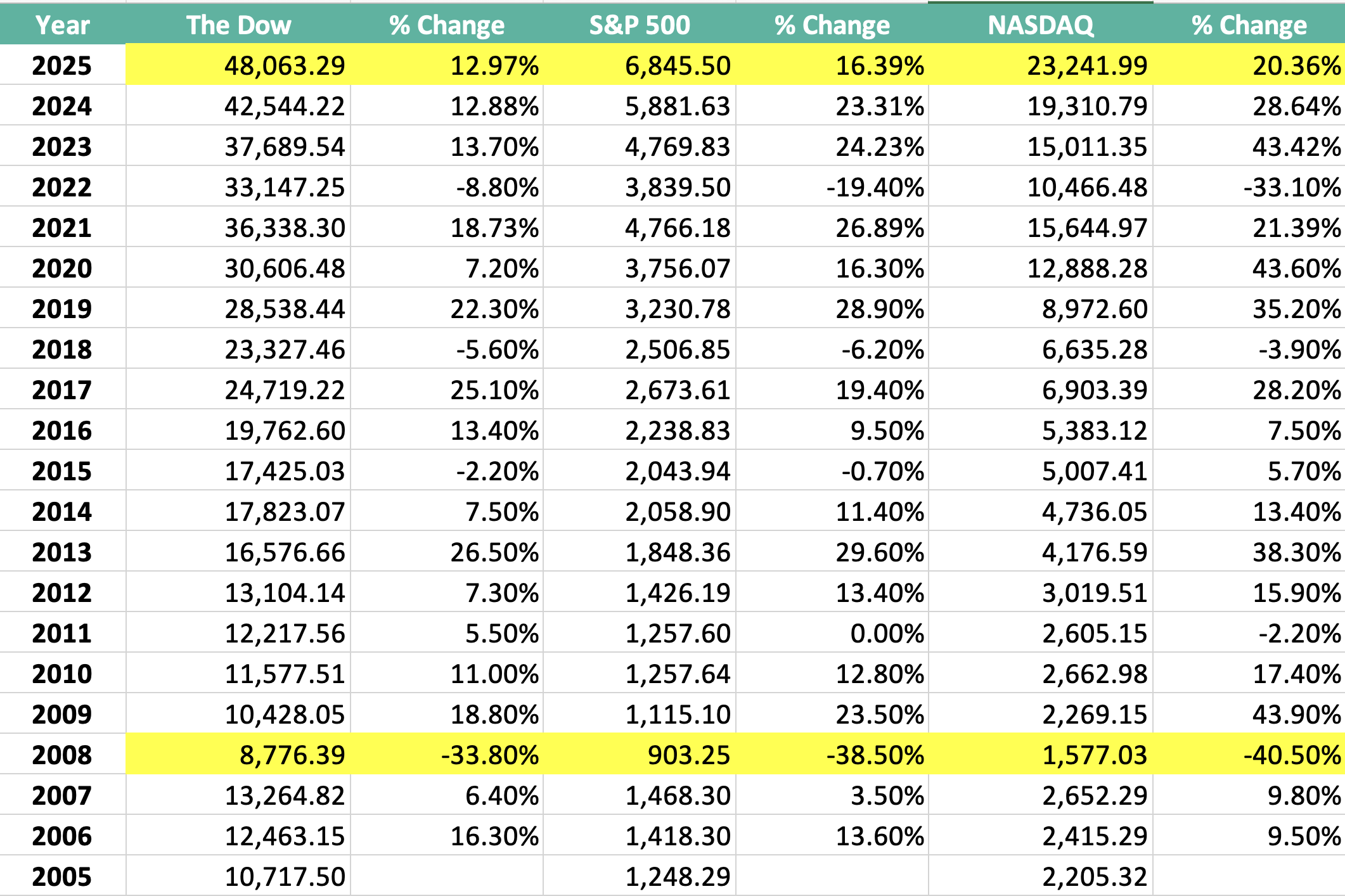
Most ETFs trading in the marketplace are index-based. An index, as explained here, is used to gauge the movement of the broad market. Some index-based ETFs seek to deliver the same return as the major US indexes: the Dow, the S&P 500, and the NASDAQ. Their recent values are shown in the table below.
The Value of the Dow, the S&P 500, and the NASDAQ
Returns of Index-Based ETFs
Let's assume you invested in an index-based ETF that tracked the Dow on the last day of 2024. Your return by the end of 2025 would have been about 12.97%, as shown in the table (in the '% of Change' column for the Dow for 2025).
Returns can fluctuate from year to year, however. Suppose you had invested $100 in an ETF that tracked the Dow at the end of 2007. Your $100 investment would have lost about $33.80 (or -33.8%, as shown in the '% of Change' column for the Dow for 2008) by the end of 2008.
Over an extended period, however, the overall return of an index ETF based on the Dow would be positive. So even if the value of an index-based ETF goes down, it will rebound in the long run. The advantage of being young is that when it comes to investing, time is your friend.
ETF Symbols
To get any information about ETFs, you need their symbols. The symbols for the ETFs associated with the three popular indexes are shown below:
1. The Dow: SPDR Dow Jones Industrial Average ETF Trust (symbol: DIA)
2. The S&P 500: Vanguard S&P 500 ETF (symbol: VOO)
3. The NASDAQ: Invesco QQQ (symbol: QQQ)
Getting Information about ETFs
Once you have the symbol of an ETF, what do you do with it? With the symbol, you can get the price of a share of an ETF, just as you can with stocks. We use Yahoo!Finance to get ETF prices. Once you enter the website, type the symbols in the search box. Here are the prices of the three index-based ETFs as of the beginning of 2026:
1. The Dow ETF price per share (symbol DIA): $483.63
2. The S&P 500 ETF price per share (symbol VOO): $628.30
3. The NASDAQ ETF price per share (symbol QQQ): $613.12
You may not have this kind of money to invest in whole shares of index-based ETFs. In that case, you can buy a fractional share if your online broker allows it.
Buy US Saving Bonds
Savings bonds are loans Americans make to the US government. View them as a way to save money, not necessarily a way to earn much interest.
Two Types of U.S. Savings Bonds
There are two types of savings bonds: Series EE bonds and Series I bonds. Both are low-risk investments that pay interest for up to 30 years.
The US Treasury no longer issues paper savings bonds. You simply register and buy them at www.treasurydirect.gov. Like any other investment, a minor needs a parent or guardian to open a custodial account in their name.
Series EE Bonds
With Series EE bonds, you are promised a fixed interest rate for the first 20 years. The US Treasury announces interest rates for new bonds each May 1 and November 1. For EE bonds issued from May through October 2026, the rate is 2.40% per year. EE bonds also come with a guarantee. At 20 years, the bond will be worth at least twice what you paid for it.
You must invest at least $25 in a Series EE bond, but you cannot invest more than $10,000 each calendar year. You can only cash in the bond after one year or more. If you cash it in before five years, you lose the last three months of interest.
Series I Savings Bonds
Series I bonds are similar to Series EE bonds, with one crucial distinction. The Series I bond interest rate is adjusted periodically based on the inflation rate. Specifically, the rate combines a fixed rate with a rate tied to the CPI-U inflation measure. For I bonds issued from May through October 2026, the annual rate is 4.26%.
Certificate of Deposits (CDs)
Checking, savings, or money market deposit accounts are great places to keep money you may need within days. But if you don't need all your money right away, you may want to put some of it into a Certificate of Deposit (CD).
Here are a couple of important things you need to know about a CD:
It offers a guaranteed interest rate for a period of time. CDs usually offer a guaranteed rate of interest for a specified time period, such as six months or one year. Once you choose the term, the bank will generally require that you keep your money in the account until the term ends (for example, until maturity).
It offers higher rates than other bank deposits. Because you agree to leave your funds in the account for a specified period of time, the institution will generally pay you a higher rate of interest than it would for a savings, checking, or money market deposit account.
Interest Rate of CDs
CD rates vary with the term and with the overall interest-rate environment. As of July 2026, the best one-year CDs at online banks pay about 4% a year. The national average is much lower, around 2%. By contrast, the 3-month CD rate in December 1980 (when inflation was shockingly high) was about 18.7%.
The highest CD rates are usually found at online banks and credit unions. When you shop for a CD, make sure the bank does not require a big minimum deposit or charge fees. Also make sure it is FDIC-insured. At the very least, a CD will force you to put money away that you cannot withdraw on a whim.