
7 Steps to Start Investing as a Teenager
by Emmanuel Modu, Author of TeenVestor: The Practical Investment Guide for Teens and Their Parents
Updated: July 4, 2026

Teen Investor
How to invest as a teenager:
Gain Basic Stock Knowledge
Identify Investments Appropriate for Teens
Learn What Companies Do
Get & Use Financial Data
Experiment With Dummy or Mock Portfolios
Choose the Right Custodial Brokerage Account for Teens
Avoid Investment Scams
More details on each step can be found below. New to all of this? Start with our complete guide on how to invest under 18 — accounts, brokers, and your first investments — then work the steps.
#1. Gain Basic Stock Knowledge
The first step for teen investors (Teenvestors) and beginning investors is to learn the basics of stock investing. Without an understanding of investing fundamentals, you risk quickly losing whatever little money you cobble together to start building your nest egg. The problem is that many resources for beginning investors are not appropriate for teens. They are simply not written in language teens can understand.
There are many free resources at your disposal to learn about investing.
1. TeenVestor.com. Our site is the only portal on the internet with a full array of free educational material for teen investors and their parents. We teach teens about stocks, funds, the economy, and more. See press materials here about us.

2. Investor.gov. This site is run by the Securities and Exchange Commission (SEC), which regulates securities in the United States. It provides investor education covering stocks, ETFs, and other investments. It even covers cryptocurrency.
3. Investopedia. An education-focused website for beginning and advanced investors. It has a great dictionary of basic investment terms, each well defined and paired with relevant articles. Investopedia has been a trusted source of investing information for many years.
4. How the Market Works. This website runs a stock market trading game. It also has an education section with lessons about the stock market.
5. Wall Street Survivor. Another site with a stock market trading game and an education section.
Another way to gain knowledge about the stock market is to sign up for an online course. We offer the TeenVestor Stock Certification Course. It consists of text, video lessons, and quizzes to help teenagers understand the stock market. Other platforms, such as Udemy, also offer courses about the stock market.
#2. Identify Investments Appropriate for Teens
The best investments for teenagers range from stocks to exchange-traded funds to low-risk assets such as savings bonds. No matter the investment, a teen under 18 cannot invest alone. You need the involvement of an adult, typically a parent, to open a custodial brokerage account or to authorize a purchase. Details on how your parents can open a custodial account so you can buy stocks and funds are here: Best Custodial Brokerage Accounts for Kids.
Finding Stocks in which to Invest
You may want to start choosing stocks based on your own interests. By looking for stocks that interest you, you are more likely to stay engaged as you learn how the market works. Here are some hints about where to look as a beginning investor:
• Your hobbies
• Businesses in which your relatives work
• Companies discussed in business publications like the Wall Street Journal
• Companies headquartered in your state
• Big companies in an index such as the Dow Jones Industrial Average or our own index, the TeenVestor Index Portfolio, shown in this article: Stocks for Kids
• Companies that produce some of the items your friends and classmates like
Speaking of items teens like, the investment bank Piper Sandler surveys thousands of US teens in a project called Taking Stock With Teens. Its most recent survey, from Fall 2025, polled about 11,000 teens. It covers shoes, restaurants, snacks, clothing, and many other consumer items and services young people use. Basing stock purchases on brand recognition is probably not the best way to decide what stocks to buy. But the companies in the survey may give you some initial investment ideas. Later, when you get more experienced, you can do fundamental research to see which stocks are worth your money.
Here are some well-known teen brands and the public companies behind them:
• Nike and Converse: Nike, Inc. (stock symbol: NKE)
• Hollister: Abercrombie & Fitch Co. (stock symbol: ANF)
• UGG and Hoka: Deckers Outdoor Corporation (stock symbol: DECK)
• Vans: VF Corporation (stock symbol: VFC)
• Lululemon: Lululemon Athletica Inc. (stock symbol: LULU)
• Coach and Kate Spade: Tapestry, Inc. (stock symbol: TPR)
• Michael Kors: Capri Holdings (stock symbol: CPRI)
• McDonald's, Chipotle, and Starbucks: McDonald's Corporation (MCD), Chipotle Mexican Grill, Inc. (CMG), and Starbucks Corporation (SBUX)
• Goldfish crackers: The Campbell's Company (stock symbol: CPB)
• Lay's: PepsiCo, Inc. (stock symbol: PEP)
• Apple Pay, Cash App, and PayPal: Apple, Inc. (AAPL), Block, Inc. (XYZ), and PayPal Holdings, Inc. (PYPL)
To see how any of these stocks has performed, plug its symbol into Yahoo!Finance.
Exchange-Traded Funds: The Less Risky Investment for Teens
If you want assets that are less risky than a handful of stocks, consider index-based exchange-traded funds (ETFs). An ETF represents a diversified group of companies but trades just like a stock. ETFs are like mutual funds, except you can buy them through your online broker the same way you buy stocks.
The ETFs appropriate for teen investors track broad market indexes such as the Dow Jones Industrial Average, the S&P 500, and the NASDAQ. These indexes cover a wide variety of large stocks. By buying an ETF backed by the Dow or the S&P 500, you diversify your investments. That makes for safer holdings.
A NASDAQ-based ETF is a bit different. The NASDAQ mostly reflects the value of technology stocks. So a NASDAQ ETF tracks those stocks rather than the entire stock market.
The ETF symbols you need for buying broad index-based ETFs are as follows:
1. The Dow: SPDR Dow Jones Industrial Average ETF Trust (symbol: DIA)
2. The S&P 500: Vanguard S&P 500 ETF (symbol: VOO)
3. The NASDAQ: Invesco QQQ (symbol: QQQ)
US Savings Bonds
One of the safest investments a teen can make is a US savings bond. Savings bonds are loans Americans make to the US government. View them only as a way to save money, not as a way to grow your nest egg through price increases, as with stocks and ETFs.
There are two types: Series EE bonds and Series I bonds. Both are low-risk investments that pay interest for up to 30 years. The Series I bond has one crucial difference. Its interest rate is adjusted periodically based on inflation.
The US Treasury no longer issues paper savings bonds. You simply register and buy them at www.treasurydirect.gov. Like any other investment, a minor needs a parent or guardian to open a custodial account in their name.
#3. Learn What Companies Do
The Annual Report
As a starting point, get a copy of the annual report of any company you may want to invest in. An annual report is a document most public companies use to disclose corporate information to their stockholders every year. It is a state-of-the-company report. It usually includes a letter from the chief executive officer and the company's financial data. It also covers results of operations, new product plans, subsidiary activities, and research on future programs.
The 10-K
Sometimes companies use a filing called a 10-K as a substitute for the annual report. The 10-K is required by the US Securities and Exchange Commission of all public companies. It contains much of the same information companies put into their annual reports. Apple, for example, uses the 10-K as its annual report. Here are the investor pages of two companies you may know: Apple and Coca-Cola.
To get the annual report of any company, search Google for the company name plus 'annual report.' For example, search 'Coca-Cola annual report.' The search will most likely take you to the investor relations section of the company's website, showing annual reports for the past few years.
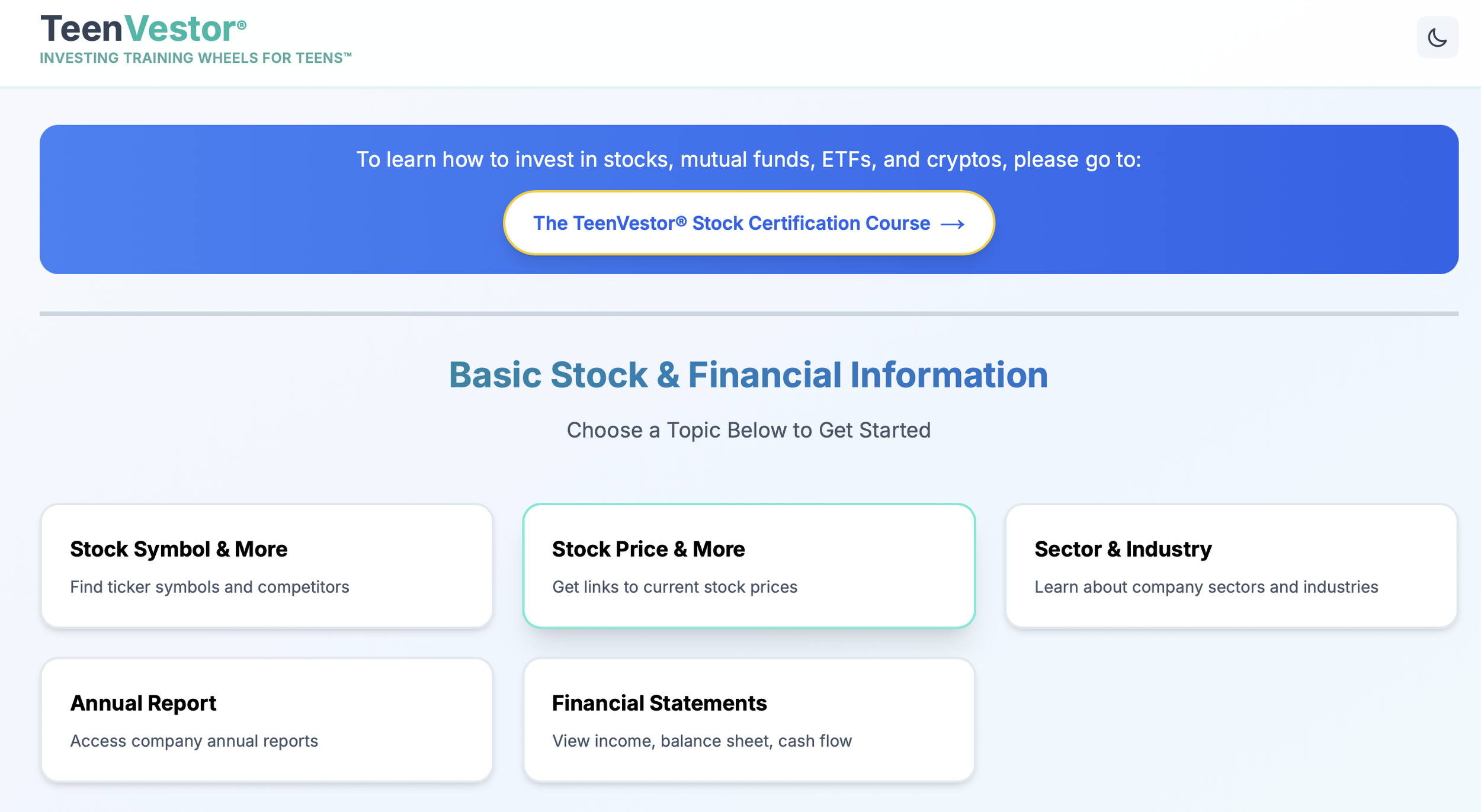
Using Our Web App to Get Information
Click on the image below to go to a web app that will help you in researching any company.

#4. Get & Use Financial Data
At some point, you will want more detailed information about a company's financial performance. How much money does it make compared to similar companies in the same industry? There are many types of performance measures. The good news is you do not have to calculate them on your own.
Sources of Company Performance Measures
Many financial websites provide the numbers you need, such as return on equity, earnings per share, and the price-earnings ratio. These are important indicators of how companies are doing. You can learn about them in a stock market course. We use four main websites to get this data for any company we want to research:
Getting Stock Symbols
Before looking up financial information on any company, you need the stock symbol for that company. Stock symbols do not always correspond with the name of the company or its products. For example, Coach bags are made by Tapestry, Inc. If you want to invest in Coach, you have to buy stock in Tapestry, which trades under the symbol TPR. So it is important to do a little research about the products you want to invest in. This link takes you to the Yahoo!Finance page for Tapestry, Inc.
#5. Experiment With Dummy or Mock Portfolios
Setting up a dummy trading portfolio is one way Teenvestors can overcome the fear of taking that first step in investing. A few sites let you set up stock market games. You compete with your friends to see who earns the highest profit in hypothetical portfolios you create with fake dollars. The sites tally the daily portfolio values and rank them by username. Here are some dummy trading portfolio portals:
• MarketWatch Virtual Stock Exchange
#6. Choose the Right Brokerage Account for Teens
Minors generally cannot open brokerage accounts on their own. In some states, a minor is anyone under 18. In others, it is anyone under 21.
Considerations for Opening a Brokerage Account
If you are a minor, you can invest under the supervision of your parent through a custodial brokerage account. Your parent signs you up for the account through an online broker. You own the assets in the account. Your parent controls the investments (hopefully, with your help) until you are no longer a minor.
A few big brokers also offer teen accounts for ages 13 to 17, such as the Fidelity Youth Account and the Schwab Teen Investor account. With these, you control the account yourself, and your parent stays connected. See How Old Do I Have to Be to Invest in Stocks? for details.
Important considerations when choosing an online trading account include:
• No stock trading fees. Find online brokers that charge $0 to buy and sell stocks and ETFs.
• No minimum balance. Make sure the broker does not require a sizeable minimum balance in a trading account. Many now offer a $0 minimum.
• Fractional shares. If you want to invest as little as $1 in reputable companies with high stock prices, the broker must allow you to buy fractions of a share.
• Low or no monthly fees. Some youth apps charge subscriptions that eat into small accounts.
Our guide How to Choose an Online Broker covers these and other things to check. Two examples: what it costs to move your account, and whether the company has staying power.
Teen-Friendly Brokers and Apps
Here are the brokers and apps we consider the most teen-friendly right now. We have split them into two groups.
Traditional, Established Brokers
These firms have been around a long time. They charge no commissions on stocks and ETFs. They have no account minimums and no subscription fees. They are also the most durable and the cheapest to leave.
• Fidelity. Offers both custodial accounts and the teen-owned Fidelity Youth Account. Commission-free, with no minimum and no subscription.
• Charles Schwab. Now owns TD Ameritrade. Offers custodial accounts and the Schwab Teen Investor account.
• Vanguard. Offers custodial (UGMA/UTMA) accounts. A large, long-established firm known for low-cost index funds.
• E*TRADE. From Morgan Stanley. Offers custodial accounts, and even custodial IRAs for teens with earned income.
• Interactive Brokers. Offers custodial accounts. A powerful platform, though more advanced than most beginners need.
• Ally Invest. Offers custodial accounts with commission-free stocks and ETFs, alongside Ally's online banking.
• Robinhood. The app that helped make commission-free trading standard. It previously did not offer custodial accounts. It now does, so teens can invest through a Robinhood custodial account.
Youth-Focused Apps
These apps are built for teens or families. They often add lessons, an allowance tool, a debit card, or parental controls. Most charge a subscription. Some can be costlier to leave. Weigh the extras against the fees.
• Greenlight. A family money app with a debit card, allowance, chores, and parent-approved investing. Subscription-based.
• Acorns. Offers custodial (UGMA/UTMA) investing for kids through Acorns Early, with automated, hands-off portfolios. Subscription-based.
• Stash. Offers a parent-run custodial account it calls a Kids Portfolio. Subscription-based. This is also where Stockpile's former customers were moved.
#7. Avoid Investment Scams
If someone promises you a profit much higher than the stock market delivers each year, you should run. The only exceptions: you really know what you are doing, or you do not mind losing your money quickly. One adage to remember: high profit in any investment usually involves much higher risk.
Comparing Promised Investment Returns to Market Returns
Over the long run, the stock market has generally returned about 7% to 9% a year, depending on the period you measure. Yes, the return can be extremely high in a single year, if you invest in an index fund that tracks the Dow Jones or the S&P 500. A fund that tracked the S&P 500 in 2020, for example, gained about 16.3%. But in 2008, the same type of fund lost about 38.5%. So no one can promise you a steady return each and every year in the stock market.
Don't Be Fooled: A High Return Always Means High Risk
Suppose someone says they will consistently earn you a profit of, say, 12% each and every year by investing in stocks (or any other asset). That person is not being truthful about the risk they are taking with your money. We have seen investment offers that promise sky-high interest rates for what are, at best, extremely risky propositions. At worst, they are pure frauds. Here is a list of red flags the Securities and Exchange Commission says should make investors suspicious of an investment offer:
• It sounds too good to be true. Mom was right! Compare promised returns to a well-known index such as the S&P 500. Any investment that promises substantially more than these readily available indexes is, by definition, risky. Risk is not always a bad thing. With more risk comes the potential to make more money. But you should know how risky something is before you invest in it.
• An unusually high 'guaranteed return.' Fraudsters spend a lot of time trying to convince investors that extremely high returns are 'guaranteed.' If a person or company you do not know promises an unusually high guaranteed return, watch out. Even if you know the company, a guaranteed profit that sounds too high should make you suspicious.
• A company that is not well known. If you have never heard of a company, broker, or advisor, spend time checking them out before you invest. Most public companies make electronic filings with the Securities and Exchange Commission at www.sec.gov. Your state securities regulator may have more information. If a supposedly upright financial firm lists only a post office box as an address, do a lot of homework before sending it your money. And if anyone mentions penny stocks, run away as fast as you can.
• Being pressured to invest 'right now.' Scam artists usually try to create a sense of urgency. They make you think you will miss a fabulous opportunity if you do not act now. But savvy Teenvestors take time to do their homework before investing. If you are being pressured, just say no. Your wallet will thank you.
• An investment that is hard to understand. Con artists frequently use big words and technical-sounding phrases to impress you. But have faith in yourself. If you do not understand an investment, do not buy it. If a salesman cannot explain a concept clearly enough for you to understand, it is not your fault. Do not make it your problem by investing in the product.
Penny Stocks Are Terrible for Teen Investors
Teen and kid investors should avoid penny stocks. These are stocks of very small companies that trade below $5. Scam artists use them to hook unsuspecting, naive investors. There is nothing necessarily wrong with the companies that issue these stocks. The problem is information. There are usually very few publicly available documents about the health of these small companies. That makes it easy for unscrupulous brokers and advisors to lure beginners in.
Penny stock prices are also easy to manipulate in so-called pump and dump schemes. Promoters talk up the value of penny stocks they hold. The price temporarily skyrockets. Then they dump their shares, leaving new investors with stock worth much less.
Cryptocurrency and Teen Investors
Before stepping into the crypto world, read our article Crypto for Teenagers for the basics of investing in cryptocurrency.
Cryptocurrency is an investment teens and kids should probably avoid for now, whether in stock form or as virtual currency. The reason is simple. The value of cryptocurrencies is too volatile. Bitcoin is the best-known cryptocurrency, and its swings are wild. It peaked at about $126,000 in October 2025. As of early July 2026, it trades at roughly $61,000. That is a drop of more than half in nine months. You can find the current value of Bitcoin here: Bitcoin.
The industry has also seen spectacular failures. In 2022 and 2023, several prominent crypto platforms went bankrupt, including FTX, Celsius, Voyager Digital, and Three Arrows Capital. Millions of customers were left with little hope of recovering their deposits.
Cryptocurrency may be fun and exciting to invest in. But at this stage, it is closer to gambling unless you know exactly what you are doing. You may want to wait a while before diving into the deep end of crypto investing.